
Maximizing Bedroom Space with Under-Bed Storage Solutions
Turning Dead Space into Functional Storage
The space beneath a bed often becomes a gathering place for stray shoes and forgotten dust. But in South African homes, where square meterage comes at a premium, that hidden void holds real potential. Choosing plastic storage boxes with lids under bed transforms this overlooked zone into a quiet archive for seasonal blankets, off season clothing, or children’s keepsakes.
Unlike flimsy cardboard alternatives, sturdy containers shield belongings from moisture and pests. They slide out smoothly on most floor surfaces. You can stack them without worrying about crushed contents. The transparency of many models allows instant identification, while opaque versions keep the room looking uncluttered.
Consider what you store most often:
- Winter duvets and extra pillows
- Out-of-season footwear
- Documents and photo albums
Even with limited clearance, low profile plastic storage boxes with lids under bed fit neatly and maximise every centimetre. Your bedroom gains order without losing an inch of floor space.
Protection from Dust, Dampness, and Pests
Humidity in Durban and Cape Town regularly climbs above 70%, turning unsealed storage spaces into breeding grounds for mould. Plastic storage boxes with lids under bed form a simple barrier against this persistent dampness.
I have seen what happens to woollen blankets stored without protection. The fabric stiffens, the smell lingers, and sometimes the damage is permanent. Containers with secure lids prevent that outcome entirely.
Dust and pests present a second threat. A sealed container keeps out the fine particles that settle on every surface, and it blocks the insects that thrive in dark corners.
- Moth larvae attack natural fibres within weeks
- Moisture causes mildew in leather and fabric
- Dust mites aggravate allergies
These risks disappear when your belongings sit inside plastic storage boxes with lids under bed. The protection is straightforward, and the difference it makes to your possessions is substantial.
Durability and Longevity of Hard Plastic Containers
The space beneath your bed commonly becomes a repository for shoes, cables, and items you forgot you owned. Plastic storage boxes with lids under bed change that. They slide out without snagging, hold their shape when stacked, and give you a clear view of what lies beneath. No more rummaging.
Durability is their clear advantage. Cardboard boxes collapse after one humid South African summer. Fabric bins lose their form quickly. Plastic storage boxes with lids under bed endure years of pushing and sliding without cracking or splitting at the handles. That is dependability I appreciate.
A sturdy container routinely survives:
- Repeated drags across carpet and tile
- Heavy blankets and books stacked on top
- Temperature swings in unheated bedrooms
Each slide in and out tests the build quality. Hard plastic passes every time. A well chosen set lasts a decade rather than a season. For bedrooms in Victorian homes or modern flats, that longevity outweighs any fabric finish.
Stackable Designs for Compact Organization
In a compact Johannesburg flat, every square centimetre carries a price. The gap between the floor and the bed frame is often surrendered to dust. I prefer to think of it as unused potential. Plastic storage boxes with lids under bed transform that void into a structured archive for off-season jackets, spare blankets, and the bicycle pump that always goes missing!
Stackable designs create the real efficiency gain. One box handles the linen; two boxes stacked accommodate an entire winter wardrobe. This vertical layering frees cupboard space for items used weekly.
What makes a stack work:
- Boxes with identical footprints
- Lids that lock without creaking
- Sidewalls that resist bowing under weight
That is how a cramped room gains usable space without adding shelving.
Selecting the Right Storage Containers for Your Bed Frame
Measuring Clearance: Low-Profile Options
Most bedroom floors have unused centimetres. A standard bed frame leaves 15 to 25 centimetres of clearance, yet people often purchase containers by guesswork. Measure that gap before anything else. The best plastic storage boxes with lids under bed sit 12 centimetres tall or less, allowing airflow without wedging tight.
Consider the floor type. Carpet adds friction, while wooden floors let boxes slide. Low profile models with reinforced bases handle these surfaces differently.
- Measure the width between bed legs
- Check the depth from headboard to footboard
- Note the height clearance at the lowest point
These numbers determine whether a wheeled unit or a simple flat bin fits. Low profile options often sacrifice capacity for compatibility, so confirm the dimensions against your space first.
Lid Types: Snap-Lock, Sliding, and Hinged
Seventy percent of storage boxes fail because of the lid, not the base. That figure comes from my years managing inventory in a Cape Town home goods store. People purchase plastic storage boxes with lids under bed without examining how the closure works. The lid type controls dust resistance, access speed, and how the box survives being dragged across the floor.
Snap-lock lids press down at each corner. They give the tightest seal for seasonal bedding. Sliding lids open with one motion, useful for weekly rotation, but the tracks collect dust. Hinged lids never detach, so no lost covers, yet the hinge adds height that may not fit your measured clearance.
Test each mechanism in the aisle. A stubborn lid betrays its purpose within the first month!
Clear vs. Opaque Containers: Visibility and Aesthetics
Few people consider how under-bed storage changes the room’s visual rhythm. The space beneath your bed frame is a horizontal line. Clear or opaque containers determine whether that line recedes or dominates.
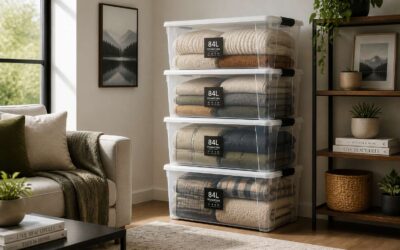
Clear containers enable quick identification. You spot the grey duvet instantly without lifting anything. The same transparency displays every crumpled pillowcase, which can feel cluttered. Opaque containers erase that visual chaos. They offer a calm facade, but they shift the burden to your memory and your labelling system.
– Do you value quick identification over visual calm?
– Does your bedroom follow a strict palette?
– Is the under-bed area visible from the doorway?
A taupe opaque bin blends into a neutral bedroom. A transparent bin with neatly rolled towels becomes a deliberate design element. Households often reserve plastic storage boxes with lids under bed for items needed instantly, while opaque containers handle seasonal overflow.
Handles, Wheels, and Easy-Grip Designs
There is a threshold to every retrieval. A bin without handles demands a crouch, a grip at the edge, a shuffle of fingers between lid and floor. That friction compounds over months. You store something out of sight and out of mind, not because you forgot it, but because pulling it out felt like a negotiation.
Handles change the geometry of the task. Cut-out grips along the sides let you hook a finger and slide. Full-length rails allow a two-handed pull. Wheels add another layer, though they require a firm floor. Carpet fights wheels, so those low-profile boxes sit on hard floors in most South African homes.
Consider what you will actually do each season:
– Slide a bin out fully before lifting
– Grip from the ends, not the middle
– Test the lid seal while moving
Plastic storage boxes with lids under bed work when the motion becomes routine.
Material Thickness and Structural Stability
Most wooden bed frames in South Africa use slats spaced 8 to 12 centimeters apart. That spacing determines whether plastic storage boxes with lids under bed sit flat or teeter on a single ridge. The frame material matters as much as the box. Pine slats flex. Hardwood slats hold firm. Steel frames change the equation entirely.
Before you measure the container, measure the frame. For plastic storage boxes with lids under bed, check the slat thickness. I have seen 15 millimeter slats bow under a heavy load. A 25 millimeter slat will not. Also inspect the side rails. If they are particle board, the structural stability will weaken over time.
- Test the slat flex with your hand!
- Check for gaps wider than your thumb
- Verify the frame has a centre support leg
The bed frame’s design dictates how much weight the under bed space can safely take. Ignore that, and you will find the lid pressing against warped slats.
Smart Organization Ideas for Under-Bed Containers
Seasonal Apparel and Extra Bedding
South African winters demand bulky duvets and woollen blankets, while summers call for lightweight linen. Rotating these items each season can overwhelm a wardrobe. Smart organization begins with categorising by frequency of use. Reserve plastic storage boxes with lids under bed for the off-season pieces, and keep a separate box for guest bedding that needs quick access.
For extra bedding, fold items into flat rectangles to maximise depth. Store matching sheet sets inside a single pillowcase to keep pairs together. Seasonal apparel benefits from a similar logic:
- Roll knitwear to prevent creases.
- Place cedar blocks between layers to deter moths.
- Label each box with the season and month for quick retrieval.
This method organises forgotten items into a system, letting you swap winter jerseys for summer cottons in minutes.
Footwear and Accessory Storage
Most South African homes own far more footwear than any closet can hold. Sandals, tekkies, and leather shoes sprawl across floors and pile up near entryways. The rest sit forgotten. Plastic storage boxes with lids under bed provide a clean answer. They slide out of sight but remain within reach.
Sort shoes by use and season. Keep summer sandals and canvas sneakers in one container. Store winter boots and closed shoes in another. Apply the same logic to accessories. Caps, belts, and handbags benefit from dedicated space.
- Sandals lay flat to avoid warping.
- Belts roll into coils that fit inside a shoe.
- Handbags rest upright in separate compartments.
Plastic storage boxes with lids under bed keep everything orderly. Swap the containers when the season shifts, and your entryway stays clear.
Holiday Decor and Gift Wrapping Supplies
The festive season brings tinsel, fairy lights, and ribbons across every surface. Gift wrap rolls lean against walls, and spare ornaments fill odd corners. Plastic storage boxes with lids under bed offer a graceful solution, keeping everything in order until the next celebration arrives.
Collect all holiday decor after the last guest leaves. Group items by room or by purpose so that next December requires no frantic searching. Wrapping paper stays flat and smooth. Delicate baubles rest safely away from the summer humidity that affects South African homes.
A simple system works well:
- Assign one box to tree ornaments and fairy lights.
- Use a second for wrapping paper, ribbons, and gift bags.
- Keep scissors, tape, and tags together in a small divider tray.
Slide the plastic storage boxes with lids under bed and close the bedroom door. The holiday items remain preserved and ready until the calendar turns again.
Children’s Toys, Books, and Games
A child’s bedroom can accumulate an astonishing number of small parts. Board game pieces, puzzle fragments, and picture books seem to migrate across every surface. Plastic storage boxes with lids under bed provide a discreet staging area for this constant flow of objects.
Sort items by current interest. One box holds the week’s favourite toys, while another stores completed puzzles and older books. This rotation keeps the collection feeling fresh without requiring new purchases. Use a third container for art supplies that need flat storage, such as colouring books and paper.
- Label each container with the child’s name and age range.
- Check the boxes every school term to remove broken items.
- Slide heavier boxes toward the wall for stability.
The lids protect against dust and curious pets. In South African homes, where humidity can warp paper, these sealed containers preserve storybooks and game boards for years.
Important Documents and Sentimental Keepsakes
Most South African households keep important documents within arm’s reach, yet fires, floods, and theft remain real threats. Under-bed plastic storage boxes with lids under bed give quiet custody to items that cannot be replaced. Birth certificates, title deeds, and old letters need a place where sunlight and moisture cannot erode them.
I keep one container for each family member. This simple system prevents rummaging through stacks of paper when you need a school report or estate document. For sentimental keepsakes, the rules change. Baby shoes, matric dance programmes, wedding cards, and grandmother’s recipe books need protection alongside the paperwork.
- Heirloom photographs and letters.
- Children’s first drawings.
- Special occasion cards and telegrams.
The rubber gasket keeps humidity out, so plastic storage boxes with lids under bed remain a dependable guardian for your family’s history.
Fitness Gear and Yoga Mats
Your yoga mat has survived gym floors and garage corners. It deserves better than being shoved behind the couch. Plastic storage boxes with lids under bed keep mats rolled tightly and resistance bands from tangling into a rubber mess. I have lost too many straps to the void behind my dresser, so trust me here.
Fitness gear collects dust and odours quickly. A sealed container solves both. South African humidity will happily turn a clean towel into a science experiment if you leave it exposed.
- Foam rollers and massage balls, corralled in one corner
- Jump ropes and straps, wound and ready for use
- Hand weights, resting on a folded towel to protect the base
Choose a box with a lid that seals properly. Your future self, reaching for gear without fighting a cobweb, will approve.
Tips to Improve Accessibility and Space Efficiency
Labeling Systems for Quick Identification
The bed’s underside is a featureless dark, a territory where objects are interred without epitaphs. Labelling restores order. Plastic storage boxes with lids under bed benefit from a clear tagging routine that spares you the ritual of lifting each lid. Affix adhesive label holders to the short side of each container, facing inward toward the space between boxes. Print category words, not full inventories, using a permanent marker or thermal printer. This makes retrieval immediate and keeps the system honest when you swap contents.
Three durable practices serve this purpose:
- Use one label holder per box, attached opposite the handles.
- Write the category in block capitals; add a date for seasonal rotations.
- Check labels twice a year and rewrite any that have faded or peeled.
This protects the archive from guessing and saves time.
Vacuum-Sealed Bags to Maximize Interior Space
Vacuum-sealed bags change the arithmetic of storage. A duvet that once claimed half a container now compresses into a slab thin enough to stack. Plastic storage boxes with lids under bed reveal their true capacity when the air is removed first.
Pull the box out completely before reaching inside. Tugging at a compressed bag while the lid is still on creates friction. Slide the container fully into the light, remove the lid, and load bulky textiles first. Lighter bags sit on top.
- Compress bulky textiles to release trapped volume
- Place vacuum bags toward the hinge edge
- Reserve the front half for frequent retrieval
This arrangement respects your knees and your patience. Sealed bags resist humidity, so the interior stays dry even when winter demands a second blanket.
Nesting and Stacking Techniques
The average bedroom yields only the space you actively reach for, and that reach usually stops at the bed frame’s edge. Most people pull a box halfway, rummage, then shove it back. Nesting smaller plastic storage boxes with lids under bed inside larger ones when the season changes prevents the collection from spreading across your wardrobe floor. This approach respects both square footage and your lower back.
Stacking follows its own logic. The heaviest bin stays at the bottom, while lighter layers sit at knee level. When you need something from the middle, pull the entire tower onto a rug before digging through it.
- Nest empty boxes within the largest unit to hold everything in one footprint
- Stack by weight, not by retrieval frequency
- Keep the base layer flush with the bed frame for a clean slide
That flush base is the quiet hero of under-bed storage. It lets you grip the front lip, tilt, and slide the whole arrangement outward without scraping your knuckles. Plastic storage boxes with lids under bed reward this intentional geometry with every season of use.
Rotating Seasonal Items with a Storage Calendar
A storage calendar turns the chore of swapping winter duvets for summer linens into a deliberate ritual. Assign each month a specific task, like March for heavy blankets and September for swimwear. When you rotate, slide out the plastic storage boxes with lids under bed and swap the contents in one smooth motion.
Keep a checklist taped inside the lid of the deepest bin. That small reminder saves you from pulling every container. I also reserve the front third of each box for the items I need next, which reduces rummaging entirely.
– Mark the calendar with two annual rotations only
– Use the same box for the same season each year
– Write the month on the label, not the season
This method respects your time and your floor space. The boxes stay in place, and your system runs quietly all year.
Using Drawer Divider Inserts Inside Boxes
Drawer divider inserts transform the interior of plastic storage boxes with lids under bed from one open space into a series of deliberate compartments. The principle is simple: vertical walls stop smaller items from slipping beneath heavier ones. A box holding toiletries, cables, or craft supplies becomes navigable without lifting a single layer.
Consider these divider applications:
– Cord management for electronics and chargers
– Partitioned sections for stationery and art supplies
– Separate cells for socks, belts, and small accessories
The inserts also improve space efficiency. Each compartment uses the full height of the container, so no air pockets form between irregular items. You can pack tighter because the dividers hold everything in place. When you slide the plastic storage boxes with lids under bed out, every item stays exactly where you left it.
Maintaining and Extending the Life of Your Storage Containers
Routine Cleaning and Sanitizing Methods
Most plastic storage boxes fail at the hinges, not the panels. A single thorough cleaning can double the useful years of your plastic storage boxes with lids under bed. Dust and grime work their way into hinge mechanisms and seam channels, causing the polymer to fatigue over time. I recommend a gentle routine using warm water and a mild dish soap. Avoid harsh solvents like bleach or acetone, which degrade the polymer structure.
For sanitizing, wipe the interior with a solution of white vinegar and water. This removes odours without leaving chemical residue. Let the boxes dry completely before replacing the lids. Trapped moisture damages stored fabric and paper items faster than anything else.
A simple monthly schedule helps:
– Wipe exterior surfaces with a microfiber cloth.
– Check the lid seals for cracks.
– Vacuum the corners where dust accumulates.
These small efforts preserve your plastic storage boxes with lids under bed and extend their service life.
Avoiding Cracks and Warping
A plastic box can lose its shape before it cracks. Temperature swings are the reason. In South African homes, midday heat softens the walls of cheaper containers, while cool nights leave them brittle. The result is a subtle bowing that pulls lids out of alignment.
Placing plastic storage boxes with lids under bed near exterior walls exposes them to damp and heat. The polymer expands, then contracts, and over time the base twists. A lid that once clicked shut now sits crooked, letting dust and humidity inside.
Signs of trouble include a base that rocks on a flat floor, a lid requiring pressure to close, and visible ripples along the bottom edge. Once warping starts, the structural integrity declines quickly.
Airflow around the boxes reduces stress on the polymer. A gap between the container and the wall allows heat to dissipate. Those measures preserve the shape of plastic storage boxes with lids under bed for years.
Preventing Musty Odors and Mildew
Most people discover mildew the morning they pull out winter blankets. The musty smell is stubborn because trapped moisture feeds dormant spores. The microclimate beneath a bed differs from the rest of a room. South African coastal cities bring high humidity, while inland evenings create condensation in unheated rooms. Placing plastic storage boxes with lids under bed in that environment means the airtight seal that blocks dust can lock in moisture present at closure.
Here is what I do to prevent the problem!
- Silica gel sachets, replaced every season
- A charcoal bag on top of the contents
- Open lids briefly on dry mornings
A thick polymer keeps its seal better than a cheap alternative, so less humid air sneaks past. But no container is fully immune. Cotton fabrics hold moisture; synthetic fabrics barely do. If you place mixed fabrics into plastic storage boxes with lids under bed, cotton should sit uppermost to release trapped dampness before it reaches deeper layers.
When to Replace Old or Damaged Boxes
Container damage often escapes notice. A hairline fracture along the hinge or a corner stress crack from repeated dragging across a tiled floor may go unnoticed for months. Yet these small breaches compromise the sealed environment that keeps bedding and clothing safe. I have seen plastic storage boxes with lids under bed develop warping after three years of use in Durban’s humid climate, where the polymer absorbs moisture and loses dimensional stability.
Annual inspection of the lid seal catches early brittleness. Run a finger along the gasket edge and note these warning signs:
- Bowing in the base when lifted while loaded
- Chalky residue on the polymer surface
- Persistent odours after thorough washing
A brittle box invites the very moisture damage it was meant to prevent. Retiring a damaged container preserves the integrity of everything else stored nearby.
0 Comments